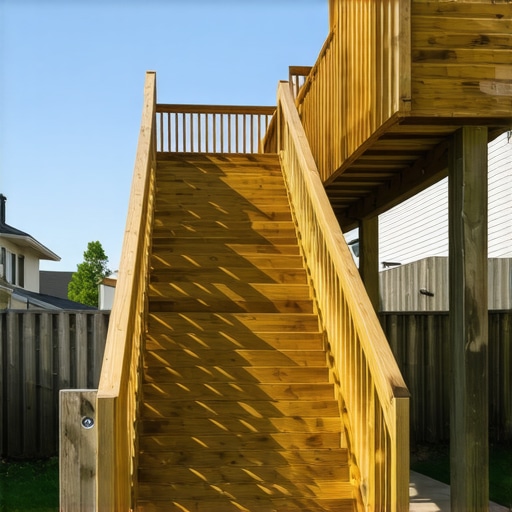
I remember the summer of 2014 like it was yesterday. I was balancing a platter of marinated ribs in one hand and a stack of paper plates in the other, trying to navigate sixteen straight steps from my lawn up to my elevated composite deck. Halfway up, my right knee did that weird clicking thing, and for a split second, I saw my life—and those perfectly seasoned ribs—flashing before my eyes. It wasn’t just about the potential mess; it was the visceral realization that I’d built a literal ladder to my backyard. Looking back, I realized I’d fallen for the same trap many homeowners do: I thought a mid-landing was just ‘extra’ work that added unnecessary cost to the project. I was dead wrong.
Why I Stopped Building Straight-Shot Staircases
That wobbly-knee moment changed how I look at safe outdoor deck access forever. When you’re staring at a tall deck project, it’s incredibly tempting to run one long, continuous stringer from the top rim joist down to the ground. It’s faster, it’s cheaper, and it involves significantly less framing math. But after years of being a professional deck builder, I’ve learned that the ‘straight-shot’ is a recipe for leg fatigue and, frankly, a bit of an architectural eyesore. Today, we’re going to talk about why that pause in the middle of your stairs is the smartest design move you can make for your home. We will solve the mystery of how to break up a massive elevation change without making your yard look like a cluttered construction zone.
Is a landing really worth the extra lumber and labor?
I get it. You’re looking at the budget and wondering if adding a 4×4 platform in the middle of your steps is just a way for contractors to pad the bill. I used to think the same thing until I realized that deck stairs that feel like a ladder aren’t just uncomfortable; they are a major liability. One of the biggest mistakes I made early in my career was ignoring the psychological ‘fear factor’ of a long, steep descent. If you have kids, pets, or older parents visiting, that straight flight might as well be a vertical climb. A landing provides a physical and mental break that makes the whole outdoor experience feel more inviting and less like a workout.
The Real Danger of the Never-Ending Stairway
There is a very practical reason the International Residential Code (IRC) actually mandates a landing for every 12 feet of vertical rise. According to the International Code Council, preventing long, uninterrupted falls is a primary safety objective in residential construction because a fall on a broken flight is statistically less likely to cause catastrophic injury than a tumble down twenty steps. Beyond just following the rules, a mid-landing gives you a chance to pivot the direction of your steps, which is vital for creating seamless transitions between different levels of your landscape. If you’ve ever felt like your stairs were pulling away from the house, you might be dealing with the hidden reason your deck stairs are pulling away from the frame, which is often exacerbated by the immense weight and leverage of a long, unsupported run. Have you ever felt a bit of vertigo looking down from your top step, or is it just me? In the next section, we’ll dive into the specific dimensions and framing tricks to make your landing rock solid.
Stop the Freefall with a Mid-Stair Landing
When you’re tackling an elevation change of more than six feet, you aren’t just building stairs; you’re building a bridge to your lawn. To keep that bridge from feeling like a diving board, you need to break the run. I always start by calculating the total rise and then splitting it exactly in half. For example, if you have a 10-foot total drop, your landing should sit at the 5-foot mark. I remember a project in Reeds Spring where we tried to squeeze a 14-step run into a tight corner. The client’s older Golden Retriever took one look at that “ladder” and refused to move. We had to pivot the design mid-build to include a 4×4 platform. Not only did the dog finally make the trip, but the homeowners realized it was the only place they could actually stop to enjoy the view of the valley without clutching the handrail for dear life.
Build a Foundation That Doesn’t Budge
A landing is essentially a mini-deck, and it needs to be framed like one. I’ve seen DIYers try to “float” a landing by just nailing it to the stringers. That is a disaster waiting to happen. You need dedicated 6×6 posts sunk into the ground with proper footings. While some might suggest 4x4s, the reason I stopped using 4×4 posts for tall decks is simple: lateral sway. When three people are standing on that landing at once, you don’t want it to feel like a cruise ship in a storm. I use 2×8 or 2×10 joists for the landing frame, ensuring I follow the joist spacing secret for a solid feeling composite surface, which usually means 12 inches on center if you’re using high-end boards.#IMAGE_PLACE_HOLDER_B#
Master the Connection Points
The most critical part of the execution is where the stringers meet the landing. This is where the hidden reason your deck stairs are pulling away from the frame often reveals itself. If you just toe-nail those stringers, the wood will eventually split or pull out as the deck settles. Instead, why I use structural screws instead of lag bolts for stairs comes down to shear strength and pull-through resistance. Use specialized stringer connectors and structural screws to “lock” the upper and lower runs to the landing frame.
Make Narrow Stairs Feel Grand
If your backyard space is tight, a landing actually gives you a tactical advantage. You can use the secret to making narrow deck stairs feel wider by flaring the bottom run out from the landing or using a “wrap-around” step design at the base. This transition is also the perfect time to think about aesthetics. I’m a big fan of the “finished” look, which is why your deck stairs should have closed risers for a modern look and safety; it prevents that “see-through” vertigo feeling and keeps small pets from slipping through the gaps. While you’re at it, don’t forget to learn how to hide the ugly edge of a composite stair tread using fascia or matching trim to ensure the landing looks like a planned feature rather than a structural afterthought. This is the core of designing safe and stylish stairs for outdoor decks in 2025: making the functional parts look intentional and beautiful.
Maintenance-Free is a Dangerous Half-Truth
Every time I walk through a showroom, I hear salespeople tell homeowners that choosing a composite deck means they will never have to worry about maintenance again. In my experience, this is the biggest myth in the industry. While the composite decking trends of 2025 focus on the longevity of the boards themselves, they often ignore the skeleton underneath. You can spend a fortune on high-end boards, but if your builder uses standard pressure-treated lumber for the frame without extra protection, you are building a ‘Ferrari body on a rusted-out chassis.’ The boards might last 30 years, but the stairs—which bear the brunt of foot traffic and water runoff—could fail in ten if you aren’t careful about choosing the right composite decking for durable low-maintenance outdoor areas and matching it with an equally durable frame.
Stop Moisture from Eating Your Stairs from the Inside Out
The ‘Oops’ factor that kills most decks isn’t the sun or the snow; it’s trapped moisture. When you screw a composite board directly onto a wooden joist, water gets trapped in that tiny gap and can’t evaporate. Over time, this creates a ‘rot sandwich.’ This is precisely the hidden cost of skipping joist tape on a new build. By applying a butyl-based tape to the top of every stringer and joist, you create a waterproof barrier that keeps the wood dry. I’ve seen 5-year-old stairs where the stringers were soft enough to poke a screwdriver through because they lacked this simple $100 upgrade. This is especially critical at the house connection point, where the drainage gap error that traps rot against your house siding can lead to structural failure of the entire ledger board. #IMAGE_PLACE_HOLDER_C#
Why does my ‘low-maintenance’ deck still feel soft after five years?
If your stairs feel springy or soft, it’s usually not the composite boards failing; it’s the wood underneath losing its structural integrity. According to the American Wood Protection Association (AWPA), wood-to-non-wood contact points are high-hazard zones for fungal decay due to limited airflow. To combat this, I’ve learned that why I always paint the cut ends of pressure-treated lumber with a copper naphthenate solution is non-negotiable. Every time a builder notches a stair stringer, they expose the untreated ‘heartwood’ of the lumber. If you don’t seal those cuts, you’re inviting the Ozark humidity to move in and stay. Combining this with the joist spacing secret for a solid feeling composite surface—dropping from the standard 16 inches to 12 inches on center for stairs—ensures the assembly feels like concrete under your feet for decades. Have you ever fallen into this trap of focusing only on the surface and ignoring the frame? Let me know in the comments.
The Precision Tools That Separated the Pros from the Amateurs
If you’re still using a standard hammer and nails for your stair assembly, you’re essentially building a disposable deck. After twenty years in the field, my most valuable tool isn’t the most expensive one—it’s the high-torque impact driver paired with structural fasteners. The visceral ‘snap’ of a lag bolt shearing off inside a stringer is a sound that still haunts my dreams. That’s why I use structural screws instead of lag bolts for stairs; they offer the flexibility and shear strength required to handle the constant rhythmic loading of people walking up and down. For the actual composite cuts, I never use a standard framing blade. I swear by a dedicated 60-tooth carbide blade designed specifically for synthetics to avoid those ugly, melted plastic ‘burrs’ on the edge of your treads. If you do mess up and strip a fastener during the build, don’t panic. Knowing the best tool for removing a single stripped deck screw can save you an hour of swearing and a ruined board.
Don’t Let Your Stairs Sink into the Mud
Even the most perfectly framed stairs will eventually fail if they are sitting directly on the soil. I’ve seen beautiful composite projects where the bottom step has warped into a ‘smile’ because the wood absorbed ground moisture. This is why your deck stairs need a concrete landing pad at the bottom. A solid 4-inch slab doesn’t just provide a clean place to step; it acts as a structural stop that prevents the entire stair stringer from ‘kicking out’ over time. I usually suggest homeowners extend this pad a few feet to create a small patio area, which is one of those innovative outdoor living ideas with composite decking in 2025 that adds massive value without a massive price tag.#IMAGE_PLACE_HOLDER_D#
How do I keep my composite stairs looking new for decades?
The beauty of composite is the reduced workload, but ‘reduced’ doesn’t mean ‘zero.’ Once a year, I take a stiff-bristle nylon brush and a bucket of warm, soapy water to my stairs. Avoid the pressure washer if you can; if you get too close, you can actually ‘etch’ the wood grain pattern right off the plastic surface. If you’ve been hosting a lot of summer cookouts, you’ll likely need to know how to get grease stains off your composite deck before they set into the pores of the material. According to the North American Deck and Railing Association (NADRA) Safety Checklist, stairs are the most common point of failure on residential decks, so your maintenance routine should always include a quick check of the ‘connection points’ for any loose hardware. My prediction for the near future? We are moving toward ‘smart frames’ where moisture sensors embedded in the joists will alert your phone if the internal wood starts to reach a dangerous saturation level. Try this today: Go out to your existing stairs and check the very bottom where the wood meets the ground; if it’s soft, it’s time to plan that concrete landing before the rot moves up the stringers.
Hard-Won Lessons from the Bottom of the Stairwell
Over the years, I’ve realized that the ‘perfect’ set of stairs isn’t the one that looks the flashiest in a brochure; it’s the one that you stop thinking about entirely. When a transition is built right, you don’t look at your feet, and you don’t white-knuckle the railing. Here are a few lightbulb moments I had after thousands of board feet of lumber:
- The ‘Coffee Test’ is Real: If you can’t walk down your deck stairs with a full cup of coffee without looking at the steps, the rise and run are off. Splitting the elevation with a landing almost always solves this.
- Safety is Invisible: The best features, like the hidden cost of skipping joist tape on a new build, are things you’ll never see once the boards are down, but they are the only reason your deck will still be standing in 2040.
- Psychology Matters More than Physics: A long, straight flight of stairs creates a ‘tunnel effect’ that makes people want to rush. A landing forces a physical pause that makes your backyard feel like a destination rather than an exit.
Gear That Keeps My Stair Builds Level and Safe
I don’t believe in hoarding secrets. If you want to build a set of stairs that rivals what a professional deck builder would deliver, you need the right reference points and hardware. I personally swear by these three resources:
- Simpson Strong-Tie Stair Connectors: I stopped ‘toenailing’ stringers a decade ago. These specialized brackets ensure the most vulnerable connection on your deck—the top of the stairs—never pulls away from the frame.
- The International Residential Code (IRC): It’s not just red tape; it’s a blueprint for keeping your family out of the ER. If you’re unsure about height requirements, always check the local safety standards first.
- High-Torque Impact Drivers: When you are driving structural screws into pressure-treated lumber, a standard drill will strip the heads. Use a pro-grade impact driver to ensure why I use structural screws instead of lag bolts for stairs becomes your new standard for strength.
Your Yard Deserves a Better Path
Building a massive elevation change can feel overwhelming, but breaking it down with a landing transforms a daunting construction task into two smaller, manageable projects. Whether you are following the latest composite decking trends of 2025 or simply trying to make your existing home more accessible, remember that your stairs are the handshake of your house. They are the first thing people touch when they visit and the last thing they use when they leave. Take the time to get the framing right, protect your wood from rot, and always aim for designing safe and stylish stairs for outdoor decks in 2025. You’ve got the knowledge—now it’s time to pick up the saw and make it happen. Have you ever felt that slight wobble on a long flight of stairs and wondered if it was time for a landing? Let me know your stair-building stories in the comments below!