I stood there, squinting in the morning light, as my heart sank into my flip-flops. There it was—a glaring, chalky-white splatter right in the middle of my pristine dark brown deck. It wasn’t just a small spot; it was a full-on aerial assault on the very boards I’d spent all spring installing. If you have ever felt that surge of protective rage over your outdoor space, you are not alone. We invest thousands into choosing the right composite decking for its beauty, but dark brown finishes have a nasty habit of highlighting every single “gift” from the local pigeon population. Today, I am going to show you how to vanish those spots without leaving behind those dreaded hazy circles or scratches that look even worse than the poop itself. [IMAGE_PLACEHOLDER]
Stop the Acid Before It Eats Your Deck Finish
Bird droppings are more than just a nuisance; they are surprisingly corrosive. Because of their high uric acid content, letting them bake in the summer sun can actually etch the surface of your capped composite. When I first started as a deck builder, I used to tell people composite was bulletproof. I was wrong. I once tried to “blast” a dried spot off a client’s stairs with a high-pressure nozzle, and I learned the hard way why you should never power wash your composite deck—it left a permanent scar in the wood-grain texture that stayed there forever. Dark colors absorb more heat, which means those droppings effectively cook onto the surface. If you are creating seamless transitions on stairs or high-visibility areas, a single overlooked spot can ruin the entire aesthetic of your home’s exterior.
Does cleaning bird poop actually require special chemicals?
Most people assume they need a heavy-duty degreaser or a bleach solution to handle the “organic matter,” but that’s often the fastest way to ruin the rich pigment of your dark boards. I’ve seen beautiful mahogany-toned decks turned into a patchy mess because a homeowner panicked and reached for the wrong bottle. Have you ever tried to scrub a spot and ended up making it three times larger? It is a sickening feeling, but we are going to fix that today. We aren’t just looking for “clean”—we are looking for “invisible.” According to researchers at the National Audubon Society, bird waste contains high levels of nitrogen and uric acid, which can act like a slow-motion paint stripper if ignored for too long. If you’ve noticed that dark brown decking in direct sunlight seems to “bake” these stains in faster, you aren’t imagining things—heat accelerates the chemical reaction. We need to act fast, but we need to act gently to preserve that “just-installed” look. My goal is to give you a process that takes less than five minutes but keeps your deck looking like a professional showroom floor.Last summer, while I was transforming your outdoor living with custom composite decking ideas for a client, I watched a junior helper reach for a metal paint scraper to pop off a dried bird dropping. I literally jumped across the joists to stop him. One slip with metal on dark brown composite and you’ve just created a permanent silver gouge that no amount of cleaning will fix. We aren’t just removing a mess; we are preserving a finish.
Get the Mess Off Without Leaving a Mark
The secret to cleaning dark boards isn’t force; it’s patience. Most people approach a dried stain like a construction project when they should be approaching it like a restoration.
Soak the Spot Like a Dirty Lasagna Pan
You wouldn’t take a chisel to a pan with burnt-on cheese, and you shouldn’t do it to your deck. The first thing I do is pour a small amount of lukewarm water directly onto the dropping. Let it sit for at least three to five minutes. This rehydrates the uric acid and softens the organic fibers. If you’re dealing with the best composite decking for high-traffic entryways, you might have multiple spots. Wet them all down at once. By the time you get back to the first one, it should be the consistency of soft mud, which is exactly what we want. #IMAGE_PLACE_HOLDER_B#
Use Soap That Respects Your Deck’s Finish
Once the spot is soft, you need a surfactant to break the bond between the waste and the capped surface. I always reach for a simple PH-neutral dish soap like Dawn. Avoid anything with “bleach-alternative” or “oxy” additives unless you want to see a light-colored ring around the spot tomorrow morning. I’ve shared similar advice on how to clean grease stains off composite without ruining the finish—the chemistry is surprisingly similar. A few drops in a bucket of warm water is all you need.
Ditch the Scraper for a Soft Bristle Brush
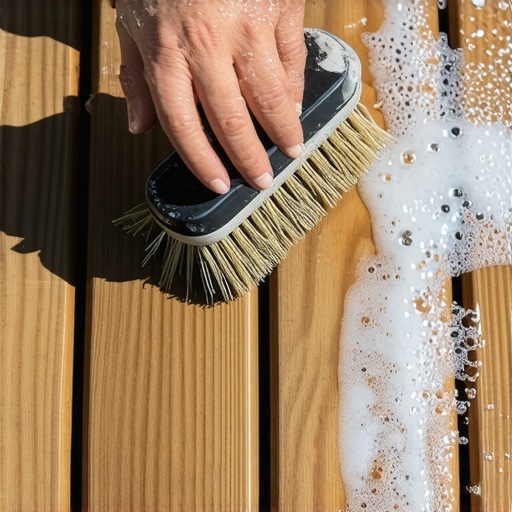
This is where the magic happens. Use a soft-bristle nylon brush—think of the texture of a soft toothbrush. Gently agitate the area in a circular motion. If the board has a heavy wood-grain texture, scrub in the direction of the grain to pull the particles out of the “valleys.” As a deck builder, I’ve seen homeowners use stiff wire brushes, and it breaks my heart every time. It shears off the protective cap layer. Remember: if the brush is too stiff for your car’s paint, it’s too stiff for your dark brown boards.
Dry the Board to Prevent Hazy Water Spots
Because dark brown decking in direct sunlight is basically a mirror for mineral deposits, you cannot just let the soapy water air dry. If you do, you’ll trade a white bird spot for a white water ring. Use a clean microfiber cloth to blot the area dry. This picks up any remaining microscopic residue. This simple 10-second drying step is what separates a DIY hack job from a professional-grade maintenance routine. If you have been struggling with recurring stains, you might want to look into how to stop bird droppings from staining your composite deck in the first place, but for the spots already there, this soft-touch method is the only way to go.People often tell me they chose composite because they never want to think about their deck again. That’s the first mistake. While the boards themselves won’t rot, the “bones” underneath usually will—and often faster than the wood decks of the 90s. Everyone says composite lasts 25 years, but in my experience, the frame rarely makes it to 15 without specialized intervention. This is what I call the “Composite Paradox.” You spend thousands on choosing the right composite decking for its durability, but you leave the structural pressure-treated lumber exposed to trapped moisture that can’t evaporate.
Why does the frame fail before the boards?
According to the building experts at the International Association of Certified Home Inspectors, moisture trapped between a non-porous composite board and a wooden joist creates a moisture trap that never dries out. This is why I always advocate for how to protect your deck frame from rot for thirty years by using joist flashing tape. If you skip this, you’re essentially building a “forever” surface on a temporary foundation. It’s the most common advanced mistake I see in modern deck builder insights.
Stop your stairs from pulling away
Let’s talk about a specific “oops” factor: stair stability. I’ve seen many pros rely on standard 4×4 posts for everything, but we actually stopped using 4×4 posts for deck stairs because they tend to twist as they dry, causing railing wobbles. Instead, we focus on double blocking the middle of a long stair run to ensure the frame is as rigid as the composite itself. Another critical trap is the stair-to-house connection. Over time, the weight and the constant expansion of the boards cause the stringers to separate from the rim joist. This is how to stop your deck stairs from pulling away from the house—you must use mechanical tension ties or structural screws. If you’ve ever felt that slight “give” when you step onto your first tread, you’re already seeing the beginning of a structural failure.
Squeaky treads ruin the luxury feel
When creating seamless transitions on stairs, a common myth is that mechanical fasteners are enough. In reality, stair treads need more than just screws to stay quiet. Because composite expands and contracts more than wood, the boards will eventually rub against the stringers. If you don’t use a high-quality sub-tread adhesive during the install, your luxury deck will sound like an old pier within two seasons. When transforming your outdoor living with custom composite decking ideas, remember that the details you can’t see are what make the project successful. Have you ever fallen into the “it’s composite, it’s indestructible” trap and ignored the frame? Let me know in the comments.
Invest in the Tools That Professionals Actually Use
After years in the field, I’ve realized that how a skilled deck builder can turn your garden into a private oasis often comes down to the high-torque, specialized hardware used behind the scenes. If you are handling your own repairs or scaling up your outdoor space, you need to stop using standard wood screws for structural connections. I’ve transitioned entirely to structural fasteners like the FastenMaster LedgerLOK. Understanding why i use structural screws instead of lag bolts for ledgers isn’t just about the speed of installation; it’s about the long-term shear strength that prevents the deck from pulling away during harsh seasonal shifts or heavy snow loads. For the finishing touches on those dark brown boards, keep a cordless heat gun in your maintenance kit. It can ‘heal’ minor surface scuffs by slightly reflowing the plastic cap of the composite, but you have to be incredibly precise. Hold the tool about six inches away and keep it in a constant, fluid motion. If you linger in one spot for even a second too long, you’ll create a permanent glossy ‘melt’ mark that reflects light differently than the rest of the board. This is where the artistry of a pro comes into play.
How do I keep my composite deck looking new for decades?
The answer isn’t found in a magic bottle of cleaner; it’s found in a rigorous, proactive inspection schedule. While homeowners love the truth about maintenance-free decking claims, ‘low maintenance’ does not mean ‘neglect-proof.’ Every spring, I recommend a ‘stability torque check’ on your stair system. Use the bracket that makes your deck stairs feel rock-solid to ensure the connection points haven’t loosened from the constant vibration of foot traffic. Also, pay close attention to the board ends, especially where the planks were trimmed to fit your frame. Most DIYers forget to treat these exposed edges. I always apply a color-matched end-sealant because the best way to seal the cut ends of composite boards is the only way to stop internal moisture from swelling the wood-fiber core of the plank. According to the technical guidelines from the North American Deck and Railing Association (NADRA), structural failure often starts at these small, unsealed points where rot can fester invisibly behind a beautiful composite facade for years before the owner notices a soft spot.
Why your next deck will probably have an app
Looking ahead, the world of composite decking trends 2025 is moving toward truly ‘smart’ structures. I’m already seeing high-end designs that incorporate built-in moisture sensors within the joist cavities and automated perimeter lighting systems that adjust their color temperature based on the sunset. We are moving away from just building a simple platform and toward creating a fully integrated, tech-enabled living environment. If you’re planning a project now, consider the acoustics and comfort of the build. You can implement the simple way to stop deck stairs from squeaking when you step by using high-grade sub-tread adhesives today so you don’t have to deal with annoying noises tomorrow. This level of foresight is what separates a basic deck from a generational investment. My challenge to you: This weekend, take five minutes to crawl under your deck with a flashlight and check one single joist for ‘dark stains’ or damp wood—if you find them early, you might just save yourself a massive replacement bill down the road.
Lessons I Had to Learn the Hard Way on the Job Site
After years of swinging a hammer, I’ve realized that composite decking isn’t just a material—it’s a complex system that reacts to its environment. One of my biggest lightbulb moments was realizing that dark brown boards require a different level of respect than traditional lumber; they are basically high-performance plastics that show every scratch like a luxury car. I also learned that picture framing your deck isn’t just an aesthetic upgrade; it’s a functional necessity to hide and protect those vulnerable end-grains from moisture. Another tough lesson? The “squeak” is almost always the builder’s fault, not the board’s. If you aren’t using a high-grade sub-tread adhesive on your stringers, you’re building a musical instrument instead of a staircase. I’ve seen that homeowners who spend just ten minutes a month doing a quick visual walk-through are far more satisfied than those who ignore their deck for five years.
The Gear I Carry in My Truck for Every Build
To get professional results that actually last, you have to move past the bargain bin at the local hardware store. For all my ledger connections, I’ve completely transitioned away from old-school methods because using structural screws instead of lag bolts provides significantly better shear strength and long-term hold. I also never start a frame without a roll of butyl joist tape—it is the cheapest insurance policy you can buy to prevent rot under your expensive boards. For technical guidance, I rely heavily on the safety standards set by the North American Deck and Railing Association (NADRA). Their annual inspection checklists are gold for spotting structural shifts before they become hazards. Finally, always keep a set of clean microfiber towels and a PH-neutral soap on hand; these are the only tools you should trust for spot-cleaning those rich, dark finishes without leaving a trace.
Take Pride in Your Ultimate Backyard Escape
A deck is more than just an outdoor platform; it is the stage where your best summer memories will happen. Whether you are currently designing safe and stylish stairs for a new project or just maintaining a space you already love, the effort you put into the small details today defines how your home feels for the next twenty years. Understanding outdoor living means respecting the materials and the structure that supports them. You now have the insider secrets to keep that dark brown finish looking pristine and your frame standing rock-solid. Now, get out there and give your deck the professional-level care it deserves. Have you ever discovered a structural problem or a stubborn stain that completely surprised you during a cleaning? Let me know in the comments below!