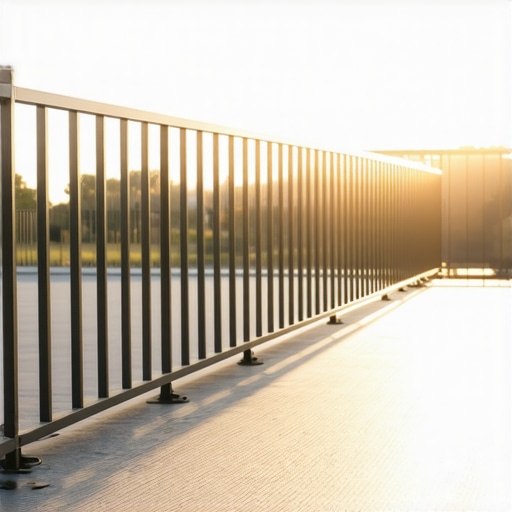
I’ll never forget the sound of my neighbor’s kids screaming last July—not from joy, but because they’d reached out to grab the deck railing while playing tag. It was a scorching Tuesday, and that sleek, black aluminum railing had been soaking up the afternoon sun for five straight hours. I ran over, touched the metal myself, and nearly blistered my palm. That was the moment I realized my obsession with the “modern industrial” look had a painful flaw. As a skilled deck builder, I pride myself on creating spaces people actually want to use, but I’d accidentally built a giant outdoor radiator.
The Heat Trap You Didn’t See Coming
We’ve all seen the Pinterest boards. Deep charcoal composite boards paired with matte black railings. It looks stunning. But if your backyard faces west, you’re essentially inviting a heat lamp into your living space. I made the mistake early in my career of prioritizing the “look” over the “feel” (literally), and I’ve spent the last three years helping homeowners fix railing issues that could have been avoided with a bit of thermal planning.The science is pretty brutal: black surfaces can be 40 to 60 degrees hotter than lighter colors when exposed to direct sunlight. According to research on the heat island effect by the Lawrence Berkeley National Laboratory, dark materials absorb up to 90% of solar energy. On a 90-degree day, that black railing isn’t just warm; it’s hitting 150 degrees or more. If you’re planning your outdoor living space for 2025, you need to think about the “ouch factor” before you sign off on those dark accents.Today, I’m going to share exactly why we’ve pivoted away from black railings for sun-drenched decks and how you can still get that high-end look without the third-degree burns. Have you ever had to pull your hand back from a deck feature because it was just too hot to touch? It’s a frustrating way to ruin a BBQ.
Is the Modern Look Worth the Burn?
I get it. You want that sharp contrast. You’ve already looked at durable composite decking options and you know black railings make those wood tones pop. You might be thinking, “I’ll just wear gloves” or “We only use the deck at night.” Trust me, you won’t. If the railing is too hot to lean on while you’re watching the sunset, you’ll stop using the perimeter of your deck entirely. You deserve a space where you can enjoy the view without worrying about where your guests (or pets) put their paws.In my early days, I didn’t think twice about it. I’d install whatever the homeowner pointed at in the catalog. But after seeing how those dark railings radiated heat back onto the deck surface—making the whole area feel like an oven—I started speaking up. There are better ways to design your dream outdoor space that keep things cool, safe, and stylish. Let’s dive into the alternatives that actually work when the sun is at its peak.
Stop Choosing Colors Based on Pinterest Swatches
It starts with understanding the concept of Light Reflectance Value (LRV). Think of it like the SPF for your outdoor living space. When you are choosing a deck color that complements your siding, you also need to check how much solar energy it traps. I once worked with a family in Naperville who was adamant about a near-black finish to match their window trim. I brought over a few samples and left them in their driveway for an hour on a sunny July morning. The dark charcoal board hit a staggering 162 degrees, while the light toasted-almond board stayed at a manageable 115. That tactile proof is why I avoid dark grey decking in sunny backyards whenever possible. To execute this correctly, aim for materials with an LRV of 35 or higher if your deck has zero shade. This doesn’t mean you’re stuck with ‘boring’ beige; silver maples, weathered greys, and light oaks offer that high-end look without the thermal penalty.
The Cocktail Rail Strategy
The ‘Cocktail Rail’ is your best friend when you want a dark aesthetic but need to keep things functional. By using a lighter-colored composite board as a flat top cap on your railing, you provide a safe place for hands to rest and drinks to sit. This isn’t just about comfort; it’s a smart design hack. When you learn the best way to install a cocktail rail on a staircase, you are essentially creating a heat break. The black metal balusters below might be hot to the touch, but the wide, flat surface on top stays cool enough for a steady hand. It’s like putting a wooden handle on a cast-iron skillet—you get the performance of the metal with a safe touchpoint. #IMAGE_PLACE_HOLDER_B#
Safety Starts Where Your Hands Land
When you are designing safe and stylish stairs for outdoor decks in 2025, the thermal strategy becomes even more critical. Stairs are where people grip the railing the hardest for balance. If the railing is too hot, a guest or a child might instinctively let go, leading to a fall. Beyond color, consider the texture of the material. Smoother powder-coated finishes tend to transfer heat more efficiently to the skin than textured grains. For the safest results, ensure the stair tread depth that feels safest is paired with a handrail in a mid-tone bronze or silver. I’ve found that aluminum railings over wood or vinyl are fantastic for durability, but you must be intentional with the color choice in high-sun areas.
Thermal Planning for the Long Haul
I remember a ‘rescue’ job where the previous builder used dark brown composite for the entire wraparound porch. The owners couldn’t even walk their dog out there at noon without boots on the paws. We ended up avoiding dark brown decking for the main floor and replaced the scorched top rails with a light weathered-grey boards. The relief was immediate. You want to be the homeowner who thinks about the thermal experience, not just the square footage. Additionally, when planning your perimeter, remember that your deck railing needs to be 36 inches high minimum, which creates a large ‘lean zone’ where guests will naturally want to rest their arms. If that 36-inch-high surface is a dark heat-sink, your guests will end up huddling in the center of the deck, leaving the edges abandoned. By mixing a dark frame with a light-colored top rail, you achieve the ‘modern industrial’ look without turning your backyard oasis into a heat trap.
The Maintenance-Free Myth That Costs You Money
I’m going to go against the grain here: composite decking is not maintenance-free. I’ve seen countless homeowners buy into the marketing hype only to be disappointed when they realize that ‘low maintenance’ doesn’t mean ‘no effort.’ When you look at the truth about maintenance-free decking claims, you realize that while you aren’t staining or sanding, you are managing a living, breathing structural system. The biggest trap I see is treating composite boards like they are simply plastic wood. They aren’t. They have different physical properties, specifically regarding how they handle weight and temperature. If you don’t adjust your frame to match the material, you’ll end up with a deck that feels ‘spongy’ or boards that warp within the first two seasons. Have you ever fallen into this trap? Let me know in the comments.
Does Your Deck Actually Grow in the Sun?
One of the most sophisticated questions I get from engineers and savvy homeowners is: how do we calculate linear expansion on a 40-foot span? Most DIYers just butt the boards together and call it a day. But according to research from the USDA Forest Products Laboratory, wood-plastic composites (WPC) have a thermal expansion coefficient significantly higher than traditional timber. On a long run, a single board can expand by as much as 1/4 inch depending on the temperature swing. If you don’t understand why your composite boards are expanding more than expected, they will eventually push against your house siding or buckle upwards, creating a tripping hazard. This is why the spacing secret for installing composite decking in winter is so critical—you are literally building for a different version of the deck that will exist in July. #IMAGE_PLACE_HOLDER_C#
Why Your Stairs Feel Like a Trampoline
If your outdoor stairs have a slight ‘bounce’ or ‘squeak’ when you step on them, you likely have a structural support issue. Many builders use the same 16-inch-on-center stringer spacing for composite that they use for pressure-treated wood. This is a massive mistake. Composite is significantly more flexible than wood. To get that rock-solid feel, your deck stairs need a middle stringer or even 12-inch spacing to prevent the treads from sagging over time. I’ve seen stairs where the lack of support caused cracking at the throat of the stringer, which is a major safety failure. Beyond just adding more wood, you should look into the simple way to stop deck stairs from squeaking by using construction adhesive and structural screws instead of just standard deck screws.
Stop Crowding Your Expansion Gaps
Another nuance that most people get wrong is the ‘picture frame’ border. It looks beautiful, but it creates a trapped end-grain situation. If you don’t leave a drainage path, pine needles and organic debris will collect in those gaps, hold moisture, and eventually rot the wood frame beneath the ‘indestructible’ composite. This is the structural reason your deck feels bouncy after a few years—the joists are failing because they couldn’t breathe. We always ensure we use double joists under every composite seam to ensure that every board end has a full 1.5 inches of bearing surface while still allowing for a 1/8-inch expansion gap. It takes more time and more lumber, but it’s the difference between a deck that lasts 10 years and one that lasts 30. Designing for innovative outdoor living in 2025 means thinking like an engineer, not just a decorator.After focusing on the structural bones, we need to talk about the tools that bridge the gap between a good deck and a lifetime deck. For me, that starts with the digital phase. In the old days, we would sketch on graph paper, but today, the reason why I never start a complex deck project without a digital 3d walkthrough first comes down to avoiding expensive change orders mid-build. I use software that allows me to show you exactly where the shadows will fall at 4 PM in August. This level of precision is why a digital designer is the best move for planning a complex backyard deck, ensuring we do not accidentally block that perfect sunset view with a poorly placed post.#IMAGE_PLACE_HOLDER_D#Once the plan is set, the hardware you choose determines if the deck stands for ten years or fifty. I have a personal rule: use structural screws instead of old-fashioned lag bolts for every ledger connection. According to the technical guidelines in the American Wood Council’s DCA 6 (Prescriptive Residential Wood Deck Construction Guide), proper fastener spacing and type are non-negotiable for long-term safety. Structural screws are heat-treated and do not require the tedious pre-drilling that often leads to split wood in older lag-bolt methods. It is a faster, stronger, and more reliable way to ensure your deck builder insights designing your dream outdoor space translate into a safe reality.
How do I keep my composite deck looking brand new for decades?
Maintaining a deck is not about back-breaking labor; it is about the right chemistry and timing. You will hear a lot of noise regarding the truth about maintenance-free decking claims, but the real secret is proactive care. For example, if you are hosting a summer cookout, you need to know how to clean grease stains off composite without ruining the finish before the oil bakes into the wood-plastic pores. I always keep a bottle of Dawn dish soap and a soft-bristle brush nearby for immediate spills. Furthermore, you can protect your deck frame from rot for thirty years by applying butyl joist tape to the top of every joist before the composite goes down. This simple step prevents water from sitting in those screw holes, which is the primary cause of frame failure I see in older decks. Looking toward the future, I predict we are going to see a massive shift toward smart decks by 2026. We are already seeing innovative outdoor living ideas with composite decking in 2025 that integrate automated shade systems and built-in sensors that alert you if moisture levels under the boards are too high. Staying ahead means using the best materials now. My advanced tip for you? Go out and buy a roll of joist tape for your next repair—it is the cheapest insurance policy you will ever buy for your home.
The Expensive Mistakes I’ll Never Make Twice
After decades of sawdust and sweat, I’ve realized that the smallest oversight often causes the biggest headaches. One of my biggest lightbulb moments was recognizing that ventilation is just as important as aesthetics. If you trap air under a deck with tight skirting, you’re creating a petri dish for mold, even with the most expensive boards. Also, I’ve learned that where you place your stairs dictates the entire flow of the party. If you are brainstorming custom composite decking ideas, always prioritize the path of least resistance to the kitchen and avoid using indoor furniture on an outdoor deck because the lack of UV protection will ruin your decor in a single season.
Another reflection: never compromise on your fasteners. In my early days, I tried to save a few bucks on generic screws, only to see them rust and bleed streaks onto beautiful boards within two years. Now, using hidden clips for the field but screws for the perimeter is my non-negotiable standard for a clean finish that actually stays put. Lastly, I’ve learned to manage client expectations regarding maintenance. It’s a lifestyle upgrade, but it still requires a quick rinse to keep it looking pristine.
#IMAGE_PLACE_HOLDER_E#
The Gear That Makes My Life Easier
When you’re ready to dive in, don’t just buy whatever is on the end-cap at the hardware store. I personally trust three main things to ensure a deck survives the seasons. First, Butyl Joist Tape. It’s the unsung hero that prevents water from rotting the wood frame beneath your composite. Second, Structural Screws. I’ve entirely moved away from lag bolts because structural screws offer superior shear strength without the risk of splitting the ledger. Third, Digital Design Tools. There is no substitute for seeing your project in 3D before a single board is cut. This is why working with a professional deck builder who uses modern modeling software is such a game-changer; it removes the anxiety and ensures every detail is perfect.
Build a Backyard That Stands the Test of Time
Building a deck isn’t just about adding square footage; it’s about creating a stage for the best moments of your life—the morning coffees, the late-night laughs, and the quiet sunsets. By choosing high-quality composite decking and paying attention to the thermal and structural nuances we’ve discussed, you’re not just building a platform; you’re building a legacy for your family to enjoy. Don’t be afraid to take the leap and start planning your renovation. If you ever feel overwhelmed by the technicalities or the layout, reach out to us for a consultation. We love turning complex backyard puzzles into seamless outdoor retreats. Have you ever had a deck project throw you a curveball because of the heat or expansion? Let me know your stories in the comments below!