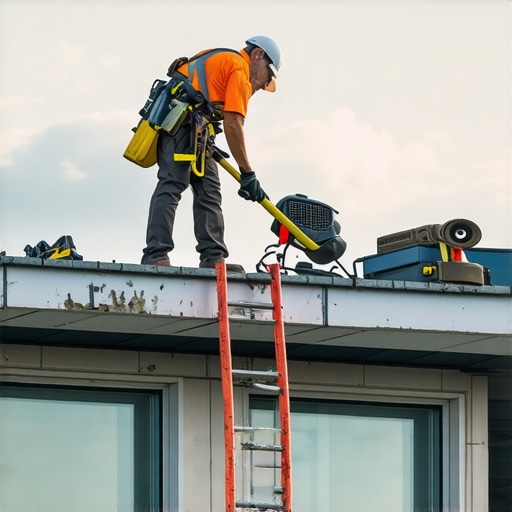
Emergency Repair Strategies for Leaking Office Roof Decks: A Property Manager’s Guide
It is 3:00 PM on a Tuesday. Your team is in the middle of a high-stakes client presentation when a rhythmic “plink-plink-plink” begins to echo through the conference room. Within minutes, a dark stain spreads across the ceiling tile, and water begins dripping onto an expensive mahogany table and a stack of sensitive server equipment. This is the nightmare scenario of a Commercial Roof Leak.
A mishandled leak is far more than an inconvenience; it is a significant financial liability. Industry data suggests that a single major leak event in a commercial setting can cause between $40,000 and $80,000 in total damage when you factor in interior repairs, equipment replacement, and business interruption. I am Jessica Cohen, a Commercial Roofing Consultant at Corporate. My career is dedicated to helping busy commercial property owners stay ahead of roof maintenance to prevent these exact issues – interior damages and full system failures – before they paralyze your operations.
When water breaches your office roof deck, the clock is ticking. You don’t just need a repair; you need an emergency response strategy that protects your assets and your bottom line. In this guide, we will walk through the immediate steps to mitigate damage and the technical solutions required to secure your building.
The First 5 Minutes: Immediate Mitigation and Triage
The first few hours of a leak are the most critical. Statistics show that the majority of secondary damage – mold growth, electrical shorts, and structural rot – occurs because of a failure to act within the first 60 minutes of water intrusion. Your primary goal is “triage.”
The Emergency Response Checklist
- Clear the Area: Immediately move computers, printers, and sensitive documents away from the drip zone. If equipment cannot be moved, cover it with heavy-duty plastic sheeting.
- Contain the Flow: Place buckets or bins under the leak. To prevent splashing (which can damage carpets and drywall), place a cloth or sponge at the bottom of the bucket.
- Create a Leak Diversion: If the water is pooling behind a ceiling tile, it may eventually collapse. Use a small screwdriver to poke a “relief hole” in the center of the wet tile to channel the water into a single bucket.
- Mark the Zone: Use “Wet Floor” signs to prevent slip-and-fall accidents, which represent a massive liability for office building owners.
Understanding What to Do When Your Office Building’s Outdoor Deck Cover Starts Leaking is essential for minimizing the initial footprint of the damage. By controlling the water’s path indoors, you buy your roofing contractor the time they need to address the exterior source.
Identifying the Source: Why Office Roof Decks are Tricky
Finding the source of a Commercial Roof Leak on an office building is notoriously difficult. Unlike a residential sloped roof where water generally moves straight down, commercial flat roofs and roof decks often involve complex layering. Water frequently enters at one point, travels laterally through the insulation or along a structural beam, and finally drips into the office forty feet away from the actual breach.
Office roof decks are particularly prone to “invisible” leaks. These decks often feature walking surfaces, pavers, or green roof elements that hide the underlying membrane. If your building has an outdoor employee lounge or a rooftop terrace, the leak could be originating from a failed flashing around a railing post or a clogged drainage scupper hidden beneath the decking boards.
To solve this, professional consultants use infrared inspections. Infrared thermography allows us to see the thermal signature of moisture trapped beneath the roof membrane. Since wet insulation retains heat longer than dry insulation, an infrared scan performed after sunset can pinpoint the exact boundaries of a leak that isn’t visible to the naked eye. If you suspect a breach, you should contact an Emergency Commercial Roofer immediately to perform a non-destructive moisture survey.
Emergency Fixes Without Tearing Up Boards
One of the biggest concerns for property managers is the cost and disruption of a full tear-off. If your office building features a rooftop deck with expensive wood or composite boards, you likely want to avoid dismantling the entire aesthetic feature to find a single puncture. Fortunately, modern Commercial Roofing technology allows for several “no-tear” emergency solutions.
For TPO (Thermoplastic Polyolefin) or EPDM (Ethylene Propylene Diene Terpolymer) surfaces, we often utilize liquid-applied PMMA (Polymethyl Methacrylate) membranes. These can be applied around deck supports and in tight corners where traditional heat-welding is impossible. These high-performance sealants create a monolithic, waterproof bond that can last for years, providing a bridge between an emergency patch and a long-term solution.
If the leak is occurring on a modified bitumen surface, reinforced cold-applied “patch kits” can be used even in damp conditions. These materials are designed to displace water and adhere to the substrate, providing an instant seal. Knowing How to Fix an Emergency Leak on a Commercial Roof Deck Without Tearing Up Boards can save a business thousands in labor costs while keeping the rooftop amenity functional for employees.
Documentation for Insurance & Liability
Once the water is contained and a temporary fix is in place, your next priority is protecting the financial health of the property. Insurance adjusters require a specific “burden of proof” to approve a claim for an Emergency Roof Leak for Office Building. If your documentation is lacking, you risk a partial or total denial of the claim.
The Documentation Protocol:
- Photo Everything: Take wide shots of the office interior, close-ups of the water entry point, and shots of the exterior roof deck. Don’t forget to photograph damaged assets, such as electronics or furniture.
- Log the Timeline: Record exactly when the leak was discovered, what the weather conditions were (e.g., wind speed, rainfall intensity), and what immediate steps were taken to mitigate damage.
- Save the Evidence: Do not throw away damaged ceiling tiles or pieces of failed membrane until an adjuster has seen them. If you must remove them for safety, store them in a dry area for inspection.
- Get a Professional Report: A simple invoice from a handyman isn’t enough. You need a detailed assessment from Peak to Peak Roofing & Exteriors that explains the cause of failure and the necessity of the repairs.
By treating the leak like a “forensic scene,” you ensure that your insurance company has all the information they need to reimburse you for both the roof repair and the resulting interior damage.
Choosing Between Temporary Repair and Replacement
Every commercial property owner eventually faces the “Repair vs. Replace” dilemma. In my experience as a consultant, I recommend the 25% Rule: If the cost of emergency repairs and ongoing maintenance over the next two years is expected to exceed 25% of the cost of a new roof system, replacement is usually the more fiscally responsible choice.
Consider the seasonal context. If you are in the Northeast or a region with heavy winter snowfall, a temporary patch in November might not survive the freeze-thaw cycles of January. In these cases, a temporary “shrink-wrap” or heavy-duty tarping system might be used to get the building through the winter before a full replacement in the spring.
When evaluating your roof deck, consider The Benefits of Working with a Professional Deck Builder in Your Outdoor Projects. A specialized contractor can help integrate the waterproofing membrane with the aesthetic decking elements, ensuring that a new installation doesn’t just stop leaks but also enhances the property value and employee experience.
Long-Term Prevention: The Maintenance Plan
The best way to handle an emergency is to prevent it from ever happening. Flat roof leak detection should be a proactive process, not a reactive one. I advise all my clients to implement a bi-annual inspection schedule – once in the spring and once in the fall.
During these inspections, technicians check for:
- Debris accumulation in drains and scuppers.
- Signs of “ponding” water that can stress the membrane.
- Cracking or “alligatoring” of the roof surface due to UV exposure.
- Separation of seams in TPO or EPDM systems.
Think of your roof deck as an extension of your office’s usable space. Just as How a Skilled Deck Builder Can Turn Your Garden into a Private Oasis, a well-maintained commercial roof deck can be a sanctuary for your staff. However, that “oasis” only remains valuable if the structural integrity beneath it is flawless.
Conclusion
A Commercial Roof Leak is an urgent challenge, but it doesn’t have to result in a total system failure. By acting within the first five minutes to mitigate damage, using infrared technology for flat roof leak detection, and maintaining rigorous documentation for insurance, you can navigate the crisis with minimal disruption to your business. Don’t wait for the next storm to test your building’s limits. Reach out to Commercial Roofers for Leaks today to schedule a comprehensive inspection and secure your office’s future.