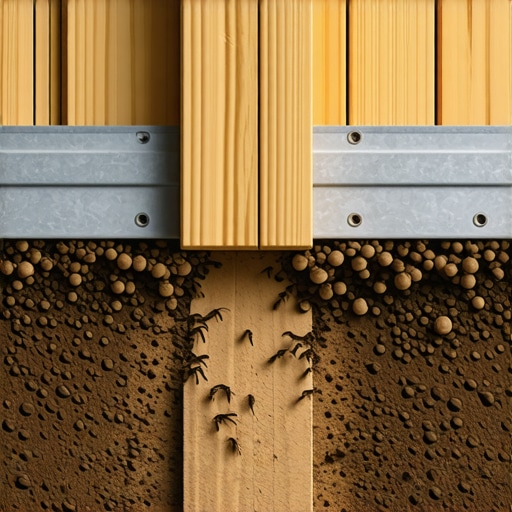
I’ll never forget the sound—a hollow, crunching snap that felt way too close to my ankles. I was just trying to sweep some leaves off my old pressure-treated stairs when the wood gave way. I hadn’t seen a single bug on the surface. No wings, no holes, nothing. But when I pulled back the ledger board, the frame was a ghostly maze of mud tubes and hollowed-out timber. My dream of a perfect outdoor space had literally been eaten from the inside out. I made the classic rookie mistake of thinking that because the wood was ‘treated,’ it was invincible. I thought the green tint on the lumber was a magic shield. It wasn’t. It turns out, subterranean termites don’t care about your labels; they care about moisture and easy access. [image_placeholder_1]
Stop Termites Before They Turn Your Foundation Into Swiss Cheese
Today, we are going to fix that. I’m going to walk you through the exact steps I take now to ensure no subterranean colony ever gets a free meal at my expense again. We’re talking about more than just spraying some poison and hoping for the best. We’re going to discuss structural barriers, ground clearance, and the specific framing moves that stop pests for good. You see, most homeowners focus on the beautiful composite decking on top, but the real battle is won or lost three feet underground. If you don’t protect the skeleton of your project, you’re essentially building a very expensive snack. According to the National Pest Management Association, termites cause over $5 billion in property damage annually, and most homeowners’ insurance policies won’t pay a dime for it. That is a massive financial hit for something that can be prevented during the early framing stage.
Can You Actually Stop Termites Without Drowning Your Lawn in Chemicals?
Most folks think the only way to fight termites is to saturate the earth with stuff you wouldn’t want your dog or kids near. I used to think the same thing until I learned about physical shields and proper ventilation. If you’ve ever wondered why your deck feels a little bouncy or soft, it might already be too late for simple fixes. However, for those of you planning a new build or a renovation, integrating a physical termite barrier is the smartest five dollars you’ll ever spend. I’ve seen beautiful homes where the deck was the entry point for an infestation that reached the kitchen. Have you ever found a soft spot on your deck and prayed it was just rot and not a termite infestation? Tell me your discovery story below. When I first started out, I completely ignored the gap between the concrete pier and the wooden post. I thought the pressure treatment would handle it. I was wrong, and it cost me an entire summer of weekends to repair. Now, I advocate for a multi-layered defense that starts with the very first shovel of dirt. Let’s look at how we can create a ‘dead zone’ that termites simply can’t cross, much like we do when we learn how to protect your deck frame from rot for thirty years.
The first line of defense isn’t a spray; it’s a simple piece of flashing. Think of termites like subterranean bank robbers who only operate in total darkness. They hate the light and they hate air. To get from their underground colony into your wooden frame, they build those tiny mud tubes you might have seen. A termite shield—a thin, non-corrosive metal plate—is like a high-intensity floodlight. It doesn’t necessarily kill them, but it forces them to build their tubes out and around the metal edge, making their presence instantly visible to anyone with a flashlight.
Put a Metal Wall Between Your Home and the Dirt
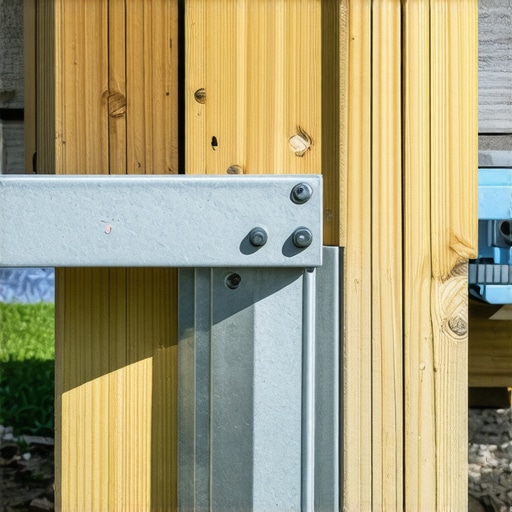
When you are setting your posts, you cannot just drop wood into a hole and pour concrete around it. Even ‘ground contact’ rated lumber eventually fails when it is trapped in a moisture-wicking concrete sleeve. Instead, you need to use a standoff bracket. I always opt for the bracket that makes your deck stairs feel rock solid because it provides a one-inch air gap between the bottom of the post and the concrete pier. This gap is the ‘dead zone.’ Termites can’t just crawl into the wood grain; they have to expose themselves to the air to bridge that inch-long gap.
The Shielding Secret That Pros Often Skip
Back in 2014, I was working on a lakeside project where the soil was basically a termite playground. We used galvanized steel shields on every single pier, extending two inches past the edge of the wood with a 45-degree downward drip edge. It felt like a massive waste of time during the framing stage. However, two years later, the homeowner called because they saw weird ‘veins’ on the concrete piers. Those were mud tubes. Because the metal shield was there, the termites couldn’t stay hidden inside the post. They were forced to build their mud tunnels over the metal, which made them incredibly easy to spot and treat before they ever touched the main ledger. If we hadn’t used that shield, they would have been eating the joists for years before anyone noticed.
Why High-Ground Clearance Is Your Best Friend
If you are building a low-profile deck, the temptation is to let the joists sit as close to the ground as possible to avoid a step-up. This is a mistake. You need at least 18 inches of clearance under your joists for proper airflow. Without it, you create a humid, dark micro-climate that acts as an engraved invitation for pests. I’ve seen cases where the structural reason your deck feels bouncy when you walk isn’t bad spacing, but rather termites that have turned the underside of the beam into a hollow shell because there was zero ventilation to dry out the wood. When you combine this clearance with the right hardware, like the reason we use structural screws instead of old-fashioned lag bolts to maintain tight, gap-free connections, you eliminate the hidden crevices where colonies start. You should also be applying joist tape to the top of every beam; while primarily for rot, it adds another layer of synthetic material that insects find unpalatable. This is a key part of how to protect your deck frame from rot for thirty years, and it happens to be a great deterrent for wood-boring pests too.
Let’s dig deeper into the biggest misconception in the industry: the idea that choosing composite means you can ignore the skeleton of your deck. Most homeowners—and frankly, a lot of budget contractors—believe that because the top surface is plastic-capped, the entire structure is now immortal. In my experience, the opposite is true. When you install high-end boards, you are effectively putting a lid on a slow cooker. The American Wood Protection Association (AWPA) has noted that moisture trapped between the bottom of a non-porous board and the top of a joist creates a micro-environment where fungal decay thrives far faster than it would on an old-fashioned cedar deck. This is the truth about maintenance-free decking claims; the boards might last forty years, but your frame might only give you ten if you do not use joist tape to break that moisture bond. Have you ever fallen into this trap of focusing only on the ‘pretty’ parts and ignoring the bones? Let me know in the comments.
Why does your expensive composite deck look like a wavy roller coaster in July?
It’s usually not a framing issue; it’s a physics issue. Wood expands when it gets wet, but composite expands when it gets hot. I’ve seen DIYers butt their boards tight against the house siding, only to find the boards buckling or popping screws when the summer sun hits them. Learning why your composite boards are expanding more than expected is the difference between a flat floor and a tripping hazard. You have to account for the ‘hangover’—the movement at the end of the run. To keep everything straight, why I always use double joists under composite seams is not just about strength; it’s about giving those expanding ends enough surface area to be fastened properly without splitting. 
Avoid the Invisible Stair Stringer Snap Before It Happens
One of the deadliest mistakes I see involves innovative stairs solutions where the builder ignores the ‘throat’ of the stringer. When you cut those triangular notches into a standard 2×12, you are leaving very little solid wood to actually carry the weight of a person. If you do not reinforce those points with proper blocking or structural screws, you will eventually find why your deck stair stringers are cracking at the throat during a high-traffic event. It is why the benefits of working with a professional deck builder often come down to these invisible structural redundancies. They understand that while a client cares about the stair tread depth that feels safest for kids and the elderly, the actual safety is hidden in the lumber you can’t even see.To keep a project from turning into a nightmare, I stopped relying on hand-drawn sketches years ago. I’ve found that why a digital designer is the best move for planning a complex backyard deck is actually about catching structural clashes before the lumber truck even arrives. If you can see the conflict between a stair landing and a window well in 3D, you save thousands in rework and wasted materials. It’s why why I never start a complex deck project without a digital 3d walkthrough first; it allows me to walk a client through the space virtually to ensure the flow and scale are perfect before a single hole is dug. 
How can I keep my composite deck looking brand new for decades?
People call composite ‘maintenance-free,’ but I prefer the term ‘low-effort.’ You still have to manage the environment to keep the finish pristine. For example, if you have a grill or an outdoor kitchen, you need to know how to clean grease stains off composite without ruining the finish immediately, as oils can eventually penetrate the cap layer if left for months. I also suggest a seasonal deep clean of the expansion gaps. I’ve written about the best way to clean pine needles out of deck gaps because when organic debris sits in those channels, it holds moisture against the joists, accelerating rot in the frame. Even bird mess needs a specific touch; the best way to clean bird droppings off dark brown composite boards avoids the abrasive scrubbing that can leave a permanent ‘dull’ spot on your high-end floor.
The Structural Hardware Revolution
The hardware you choose is just as critical as the boards you walk on. I’ve seen standard lag bolts fail because they simply don’t offer the same shear strength as modern structural alternatives. According to Simpson Strong-Tie’s technical documentation in their Deck Connection and Fastening Guide (F-DECK-22), lateral load connections are vital for preventing the entire structure from pulling away from the house during high-traffic events. This is exactly why your deck ledger needs a tension tie to stay secure. Looking forward, I predict we will see the rise of ‘cool-core’ technology across all major brands to address the heat issues I discussed in why dark brown decking gets significantly hotter than light gray boards. We might even see integrated moisture sensors that alert your phone if the frame humidity hits a danger zone for rot. My advanced tip for you today: Don’t just gap your boards from each other; gap them from the house siding. If you don’t know how to stop composite boards from expanding into your vinyl siding, you’ll end up with warped boards and cracked J-channel. Take five minutes this weekend to check your expansion gaps—it’s the easiest way to prevent a mid-summer buckle.
Hard Lessons I Learned While Building the Perfect Skeleton
If I could go back to that afternoon I fell through my stairs, I would tell myself that the prettiest deck in the world is just a liability if the frame is not bulletproof. First, never assume ground contact means indestructible. Wood is organic; it wants to return to the earth, and termites are just the cleanup crew. Second, the gap is your best friend. Whether it is the bracket that makes your deck stairs feel rock solid or the space between your boards and the siding, airflow prevents the rot that attracts pests. Lastly, realize that the truth about maintenance-free decking claims is that the low-maintenance part only applies to the top surface—the bones still need your protection and attention to detail.
The Gear That Keeps My Decks Standing for Decades
When you are ready to stop guessing and start building, there are a few resources I swear by. I never start a project without a virtual blueprint; why a digital designer is the best move for planning a complex backyard deck is simply because it catches structural errors before they cost you thousands. For hardware, I strictly follow modern lateral load requirements to ensure the structure never shifts. For the finishing touches, I always keep a bottle of high-quality degreaser nearby; knowing how to clean grease stains off composite without ruining the finish has saved many a family dinner party. If the technical side feels overwhelming, do not hesitate to look into the benefits of working with a professional deck builder who can handle the structural heavy lifting for you. [image_placeholder_5]
Start Your Journey Toward a Stress-Free Backyard
Building a deck is more than just a home improvement project; it is about creating a sanctuary for your family and friends to gather. While the threat of termites and rot can seem daunting, the right preparation makes you the master of your domain. Use the best materials, respect the physics of expansion, and always prioritize the safety of your stairs. When you build with intention, your composite decking will not just look great—it will provide a solid foundation for memories that last a lifetime. Have you ever discovered termite damage in a place you thought was safe? Let me know your story in the comments below!