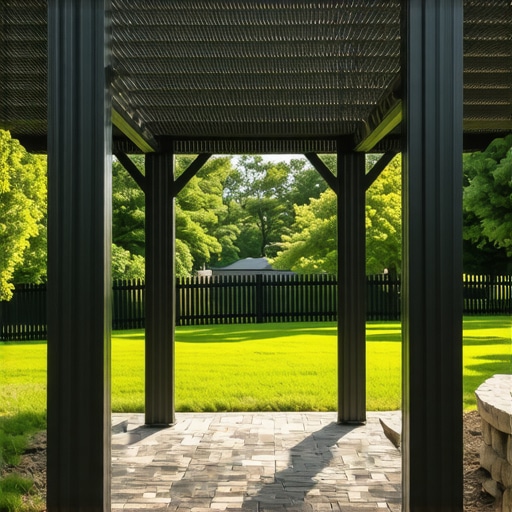
Why I Stopped Using Standard Wood for Pergola Posts in Branson West
When I first began my career in landscape architecture, graduating with a Master’s from Kansas State University, I had a romanticized vision of the Ozark landscape. I envisioned cedar beams weathering to a beautiful silver-gray and the organic warmth of heavy timber structures anchoring the hillsides of Reeds Spring and Branson West. However, years of leading sharper edge landscaping projects have taught me that the Ozarks are not just a beautiful backdrop; they are a demanding testing ground for building materials. Today, I’ve made a definitive shift in how we approach outdoor structures. I have officially stopped using standard wood for pergola posts in our high-end projects, and for homeowners in the Tri-Lakes area, understanding why is critical to protecting your investment.
At sharper edge landscaping, we specialize in landscape design services that prioritize longevity. While wood remains a staple for many builders, the unique environmental pressures of Southwest Missouri – ranging from extreme humidity to rocky, moisture-retentive soil – create a “perfect storm” for timber failure. Many homeowners believe the “gravity myth” – the idea that a massive, heavy pergola doesn’t need advanced anchoring because its own weight will keep it in place. In reality, Ozark winds and soil shifts can easily compromise an unanchored or poorly material-selected structure. To ensure our clients get the best results, we’ve moved toward more durable, engineered solutions. For more on how we approach these builds, check out The Benefits of Working with a Professional Deck Builder in Your Outdoor Projects.
The “Post-Base” Problem: Why Standard Wood Fails at the Ground Level
The most common point of failure for any pergola in Branson West or Reeds Spring is the intersection where the post meets the ground. For decades, the industry standard was to take a 4×4 or 6×6 pressure-treated wood post and either bury it directly in the dirt or encase it in a concrete footing. As a provider of hardscaping and landscaping, I have seen the aftermath of this method hundreds of times. Even “ground-contact” rated lumber is not immune to the relentless moisture wicking that occurs in our region.
Wood is essentially a bundle of vertical straws. When a wood post is set in concrete, the concrete acts as a reservoir, holding moisture against the grain. Through capillary action, the wood wicks that moisture upward. In the heat of a Missouri summer, the exterior of the post dries, but the core remains damp. This creates the ideal environment for fungal growth and rot. Within five to seven years, a post that looks solid on the outside can be completely hollowed out at the concrete line. This is why we transitioned to a specific post-base trick that prevents rot at the concrete line, involving standoff brackets that keep the wood physically separated from the moisture source. You can read more about this technical solution here: The post-base trick that prevents rot at the concrete line.
Furthermore, the soil in Branson West is notoriously rocky and clay-heavy. This soil type doesn’t drain quickly. When we provide professional lawn care services or lawncare and snow removal, we see how the water sits in the upper layers of the earth. Standard wood posts, even those treated with chromated copper arsenate (CCA) or alkaline copper quaternary (ACQ), eventually succumb to the constant hydrostatic pressure. The “sharp lawns” we maintain deserve structures that are as resilient as the turf itself, which is why the shift away from standard wood posts was a necessary evolution for sharper edge landscaping.
The Ozark Climate Factor: Humidity, Wind, and Soil
Building high end landscaping in Lampe or Branson West requires an intimate understanding of the local microclimate. The Ozarks experience extreme humidity swings. In the morning, your outdoor living space might be shrouded in heavy mist from Table Rock Lake; by afternoon, it’s baked in 95-degree heat. Standard wood posts react violently to these changes. As the moisture content in the air fluctuates, the wood expands and contracts. This leads to “checking” – the deep cracks you see running down the length of a timber – and warping.
A warped post isn’t just an aesthetic issue; it’s a structural one. When a 6×6 post twists, it puts immense stress on the rafters and headers of the pergola. This can pull fasteners loose and compromise the entire “wind lift” resistance of the structure. Many homeowners underestimate the wind speeds we get off the lake. The “gravity myth” suggests that a 2,000-pound pergola isn’t going anywhere. However, a pergola acts like a sail. Without proper structural posts and anchoring, a strong Ozark gust can exert thousands of pounds of upward pressure. If your posts are already weakened by rot or warping, the risk of catastrophic failure increases significantly.
This is a primary reason why landscape design services must account for more than just “the look.” We have to account for the physics of the site. Sloped yards, which are common in our area, add another layer of complexity. If you’re curious about the challenges of building on our local terrain, see Why Most Branson West Hardscaping Projects Fail on Sloped Ozark Yards. At sharp lawn (also known as sharp lawns or sharp edge landscaping), we’ve realized that standard wood simply cannot offer the long-term stability required for these challenging conditions.
Steel vs. Wood: The Structural Truth
If we aren’t using standard wood, what are we using? For high end landscaping projects that demand a lifetime of durability, we have shifted toward powder-coated steel and structural aluminum. The difference in performance is staggering. When you compare a traditional wood post to a modern steel alternative, you are looking at the difference between an organic material that is actively trying to decompose and a manufactured material designed for structural permanence.
- Checking and Twisting: Steel does not check. It does not twist. It does not warp. When we install a steel pergola post in Reeds Spring, it stays perfectly plumb for decades. Wood, conversely, begins to move the moment it is installed.
- Load-Bearing Capacity: A 4×4 steel post has a significantly higher load-bearing capacity than a 6×6 wood post. This allows for sleeker, more modern landscaping services designs without sacrificing safety.
- Resistance to Pests: Termites and carpenter ants are a reality in the Ozarks. While they love the soft interior of a damp wood post, they have no interest in steel or aluminum.
- Finish Longevity: Modern powder coating is chemically bonded to the metal. It doesn’t peel or flake like the stain on a wood post.
In my professional experience, there is a clear “structural truth” that many contractors won’t tell you: “This would collapse in wood… but not this.” We often design cantilevered elements or wide-span headers that would require massive, unsightly wood beams to support. By using steel, we achieve a level of architectural sophistication that standard hardscaping and landscaping simply can’t match. This philosophy extends to other parts of the home as well; for instance, I often recommend similar upgrades in other areas, such as why I prefer powder-coated aluminum over vinyl railings, which you can read about here: Why I prefer powder-coated aluminum over vinyl railings.
Maintenance and Long-Term ROI for Homeowners
One of the most frequent questions I get at sharper edge landscaping concerns the cost. Yes, steel or high-grade structural aluminum posts are more expensive upfront than standard pressure-treated lumber. However, when you look at the Return on Investment (ROI), the “cheaper” wood option quickly becomes the most expensive choice you can make.
Consider the maintenance schedule for a wood pergola in Branson West. To keep it from rotting and graying, it needs to be cleaned and stained every two years. For a standard-sized pergola, professional staining can cost between $800 and $1,500 depending on the complexity. Over ten years, you’ve spent $4,000 to $7,500 just on maintenance. And even with that maintenance, the posts are still susceptible to ground rot. If a post fails, the cost to “jack up” the pergola and replace the structural support is immense – often requiring a near-total teardown.
In contrast, modern metal posts are “set it and forget it.” They require an occasional rinse with a garden hose – something our professional lawn care services teams can handle in minutes. When you factor in the avoided maintenance costs and the increased property value of a permanent, high-end structure, the metal option is the clear winner for any savvy homeowner in Lampe or Reeds Spring. We believe in building things once and building them right. This same logic applies to decking materials; choosing the right composite decking is essential for a low-maintenance lifestyle. Learn more here: Choosing the Right Composite Decking for Durable, Low-Maintenance Outdoor Areas.
Professional Installation: Beyond the Big Box Store
There is a significant difference between a “handyman” pergola and a project designed by landscape design services. Many homeowners are tempted by the pre-built kits or the “standard” plans found at big box stores. These kits almost exclusively use thin, standard wood posts that are not rated for the wind loads or the specific soil conditions of the Ozarks.
At sharper edge landscaping, my Master of Landscape Architecture background allows us to perform actual load calculations. We look at the “tributary area” of the roof, the local wind speed ratings for Stone and Taney Counties, and the soil bearing capacity. We often find that “off-the-shelf” solutions are fundamentally flawed. There is a “hidden flaw in pre-built deck stairs and structures from big box stores” that often carries over to their pergola kits – namely, the use of undersized fasteners and low-grade lumber that cannot withstand the test of time. You can read more about these structural pitfalls here: The hidden flaw in pre-built deck stairs from big box stores.
Professional installation also means proper footings. In Branson West, we don’t just “dig a hole.” We ensure that footings are deep enough to get past the frost line and designed to shed water away from the post base. When we use metal posts, we use specialized internal mounting systems that are bolted into the concrete, providing a level of shear strength that wood simply cannot provide. This is the hallmark of high end landscaping – it’s not just about what you see above the ground, but the engineering that happens beneath it.
Conclusion: Building for the Next Generation
The transition away from standard wood posts wasn’t a choice made overnight. It was the result of years of observing how the Ozark climate treats organic materials. At sharper edge landscaping, our goal is to create outdoor spaces that our clients can enjoy for decades, not just a few seasons. By moving to steel and structural aluminum, we eliminate the primary point of failure in pergola construction, providing a safer, more beautiful, and more cost-effective solution for homeowners in Branson West, Reeds Spring, and Lampe.
If you are looking for landscaping services that combine the aesthetic eye of a Master of Landscape Architecture with the practical durability of modern engineering, we are here to help. Whether you need lawncare and snow removal or a complete outdoor living transformation, sharp lawn is committed to excellence. Don’t settle for “standard” when you can have a structure built to last a lifetime.
Ready to upgrade your outdoor living space with a structure that won’t rot, warp, or fail? Contact Us today for a professional consultation and let’s build something extraordinary together.