The Grading Trick That Saves Branson Landscaping from Ozark Runoff
Living in the Ozarks offers some of the most breathtaking vistas in the Midwest. From the rolling hills surrounding Table Rock Lake to the rugged bluffs of the White River basin, the scenery is unmatched. However, as any homeowner in the Springfield-Branson corridor will tell you, that beauty comes with a significant topographical tax. For 21 years, I’ve been on the front lines of this battle with Greenscapes Lawn & Landscape. My name is Dustin Holden, and if there is one thing two decades in this red clay has taught me, it’s that water always wins – unless you know how to talk to it.
In our region, “Ozark Runoff” isn’t just a weather report; it’s a destructive force. We deal with a unique cocktail of thin topsoil, dense limestone shelves, and steep grades that turn a standard Missouri thunderstorm into a hydraulic assault on your property. Most homeowners think of grading as simply “leveling the yard” to make it look nice. But in the world of professional branson landscaping, grading isn’t about making things flat. It’s about a concept we call “redirection and retardation.” Today, I’m going to share the professional “trick” we use to keep the Ozarks from washing your investment down into the hollow.
Why Branson’s Topography is a Landscaping Nightmare
To understand why your yard is eroding, you have to understand what’s beneath your feet. The Springfield-Branson area sits on a karst topography, characterized by soluble rocks like limestone and dolomite. While this creates our famous caves, it also means our soil – largely comprised of “Ozark Red Clay” – is incredibly dense and unforgiving. When heavy rains hit, the soil saturates almost instantly. Once that happens, the water has nowhere to go but across the surface.
Because of our steep slopes, this surface water gains velocity at an alarming rate. It’s not just “wet ground”; it’s a moving sheet of energy. If your site isn’t graded correctly, this energy is directed straight toward your home’s foundation or your expensive hardscaping. According to 417 Magazine’s report on the Springfield Stormwater Crisis, regional runoff issues have become increasingly severe as development increases, leaving less permeable ground for water to soak into. In Branson, improper grading doesn’t just lead to a muddy lawn; it leads to catastrophic foundation failure, basement flooding, and the loss of thousands of dollars in plant life.
The “rock and clay” reality of the Ozarks means traditional drainage solutions used in the flatlands of the Midwest simply won’t work here. You can’t just dig a hole and hope for the best; you have to engineer a path for the water to follow.
The “6-Inch Rule” and Foundation Protection
Before we get into the advanced tricks, we have to cover the non-negotiables. One of the most common mistakes I see in branson landscaping is homeowners (and even some inexperienced contractors) bringing soil or mulch up too high against the house. In our climate, this is a recipe for disaster.
The “6-Inch Rule” is the industry standard, but in many Ozark spots, I prefer an 8-inch margin. You must have at least 6 to 8 inches of your foundation showing between the ground level and the start of your siding or sill plate. Why? Because Ozark red clay holds moisture like a sponge. If that soil is in contact with your home’s framing, it will wick moisture upward, leading to wood rot and creating a highway for termites. Furthermore, during a flash flood – which is common in Taney and Stone Counties – that 6-inch buffer provides the necessary clearance to prevent water from cresting over the foundation wall and entering your home.
Proper site grading starts here. We slope the ground away from the foundation at a minimum of 5% grade (about 6 inches of drop over the first 10 feet). This ensures that even in a torrential downpour, the water’s first instinct is to move away from your living space.
The Secret Weapon: The Strategic Swale and Berm Combo
Now, let’s talk about the “trick” that separates the amateurs from the veterans. When you’re dealing with a steep Ozark slope, you can’t always just “slope it away.” Eventually, that water is going to hit a flat spot or a neighbor’s property. The solution is the **Strategic Swale and Berm Combo**.
A swale is a shallow, wide ditch designed to move water horizontally across a slope rather than letting it run straight down. A berm is a raised mound of earth placed immediately on the downhill side of that swale. Together, they act as a “catch and release” system. The berm stops the downward momentum of the water, and the swale channels it safely toward a designated exit point – like a natural woods line or a municipal storm drain.
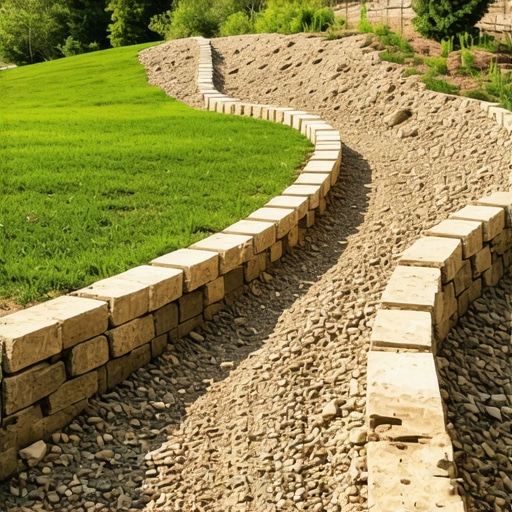
In high-end branson hardscaping, we don’t just leave these as dirt ditches. We turn them into “dry creek beds.” By lining the swale with large Ozark river rocks and boulders, we achieve two things:
- Stabilization: The rocks prevent the water from eroding the swale itself.
- Aesthetics: It becomes a beautiful landscape feature rather than a drainage pipe.
This technique is especially vital when building structures. If you’re planning a deck, for instance, you need to ensure the area beneath it is graded to prevent ponding. I’ve written extensively about the drainage trick for creating a dry storage space under your deck, which utilizes these same swale principles to keep the area bone-dry and functional.
Hardscaping as a Drainage Solution
In the Branson area, hardscaping is rarely just about looks. Because of our verticality, hardscaping is almost always a structural necessity. Retaining walls are the backbone of Ozark water management. A well-placed retaining wall breaks a steep, dangerous slope into manageable, flat tiers.
When we design these tiers, we aren’t just creating planting beds. Each wall is an opportunity to install “behind-the-wall” drainage. This usually involves perforated pipes and clean gravel that collect water from the upper tier and move it safely to the sides. Without this, the hydrostatic pressure from a heavy Missouri rain would eventually push the wall over.
This is why why tiered decks are the superior choice for steeply sloped backyards. By mirroring the natural tiers of a graded landscape, a multi-level deck allows you to navigate the elevation changes of your property while the ground beneath is engineered to handle the runoff effectively.
Professional Grading vs. DIY: The Cost of a Mistake
It’s tempting to rent a skid steer for a weekend and try to “level out” the backyard. However, site grading in the Ozarks is a high-stakes game. According to research from Flat Creek Excavating, professional site grading involves a complex process of stripping topsoil, reshaping the subsoil for structural stability, and then re-applying the topsoil. It’s not just moving dirt; it’s managing the soil’s “angle of repose.”
Furthermore, there are legal ramifications. The Branson City Landscaping Code has specific requirements regarding “runoff retardation.” This means you are legally prohibited from grading your property in a way that increases the volume or velocity of water flowing onto your neighbor’s land or the public street. A DIY mistake can lead to a “drainage dispute” with neighbors or fines from the city.
Professional graders also have the equipment to handle the “Ozark surprise” – hitting a massive limestone ledge six inches below the surface. When that happens, you need more than a shovel; you need a mini-excavator with rock teeth and the experience to pivot the entire drainage plan on the fly.
Integrating Your Deck with Ozark Grading
If you are building a deck in Branson, your deck builder and your grader must be in sync. The most common point of failure I see in modern construction is the “sinkhole effect.” This happens when a deck is built on freshly moved soil that wasn’t properly compacted or graded for drainage.
If water is allowed to pool around the concrete footings of your deck, the soil will eventually soften, causing the posts to shift or sink. This is the post-base mistake that causes modern decks to sink into the mud. To prevent this, the grading must be completed *before* the footings are poured, ensuring that every post sits on a high point relative to the immediate surrounding soil, with a clear path for water to exit the area.
In the Ozarks, we often use “pier-to-grade” transitions where the landscaping and the deck structure meet. This requires a precise understanding of how the final grade will interact with the deck’s stairs and skirting. It’s a dance between the carpenter and the landscaper that determines whether your backyard feels like a cohesive retreat or a series of disconnected projects.
Conclusion: Protecting Your Ozark Investment
Grading is the invisible foundation of every beautiful yard in Branson. You can spend thousands on exotic plants and high-end composite decking, but if you haven’t mastered the “trick” of redirection and retardation, the Ozark elements will eventually reclaim your space. By using strategic swales, respecting the 6-inch foundation rule, and integrating hardscaping as a drainage tool, you can create a landscape that stands the test of time – and the next Missouri monsoon.
Don’t wait for the next flash flood to find out where your yard’s weak spots are. Whether you are planning a new branson hardscaping project or a custom deck, professional site evaluation is the first step. Contact us today to ensure your Ozark investment is protected from the ground up.